Demystifying Peristaltic Pumps
What is a Peristaltic Pump?
Peristaltic pumps also known as a hose pump are a type of positive displacement pump. These pumps use the principle of peristalsis as the foundation for their unique design. The term peristalsis refers to the alternating contraction and relaxation of muscles around a tube that force fluid through it.
Hose pumps consist of a casing that is partly filled with lubricant and coolant, within the casing it has a flexible hose that is squeezed by alternating rollers or shoes to draw product in and then push it out of the pump. The type of hose enclosed in the pump is chosen based on the application to ensure the material suits the process fluid.
How does a peristaltic hose pump work?
A hose pump works by either two shoes (high-pressure applications) or rollers (low-pressure applications) rotating on a wheel inside of the pump and compressing an internal hose, which then forces through an exact quantity of fluid. The hose inside of a peristaltic pump is designed to return to its original shape after the shoes or rollers have passed over, so the quantity and flow of fluid are consistently maintained.
These pumps are used in various industries such as pharmaceutical industry, water and wastewater treatment, food and beverage Industry as well as the chemical processing.
For a further understanding of the working principle on peristaltic pump the process of pulsation is explained below.
The pulsation in a hose pump refers to the rhythmic, pulsating flow of fluid that is characteristic of the peristaltic pumping action. This pulsation is a direct result of the way peristaltic pumps operate, using a flexible tube or hose and rollers or shoes to compress and release the tubing cyclically.
The following occurs during pulsation:
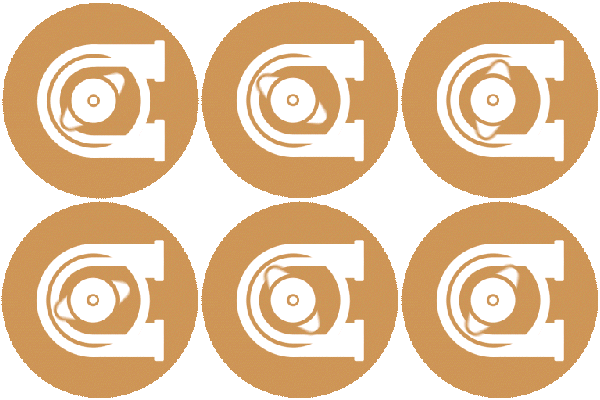
Compression Phase: the rollers or shoes of the pump head compress the flexible tube against a rigid surface. This action creates a moving seal that progresses along the length of the tube.
Fluid Displacement: while the tube is compressed, it pushes the fluid ahead of the moving seal, causing the fluid to move through the tubing.
Relaxation Phase: after this phase, the tube relaxes as the rollers or shoes move away. The relaxation phase allows the tube to refill with fluid for the next compression cycle.
Repetition: the compression and relaxation phases are repeated cyclically as the rotor of the peristaltic pump continues to turn. This repetition generates a series of pulses in the fluid flow.
Pulse Characteristics: the pulsation in a peristaltic pump is typically characterized by distinct pulses or waves in the fluid flow. The magnitude and frequency of these pulses depend on factors such as the pump speed, tubing size, and the number of rollers or shoes in the pump head.
Flow Control: The flow rate and pulsation in a peristaltic pump can often be controlled by adjusting the pump speed. Higher speeds generally result in a higher frequency of pulses and a higher flow rate.