What food and beverage pumps need to fit Clean-in-Place systems
Clean-in-place (CIP) is one of the most important and least glamorous parts of food and beverage production, and the pump's role in making it work is frequently underestimated at the specification stage. Most engineers focus on flow rate, pressure, and product compatibility when selecting a pump, treating CIP performance as a given rather than a variable that needs to be assessed on its own terms.
It isn't a given. The pump type, internal geometry, surface finish, and seal design all directly affect how well a CIP cycle cleans, how long it takes, and whether the line can be validated to the required standard. This article covers what CIP demands of a pump, which pump types handle those demands well and why, and what the practical consequences of a poor CIP specification look like on the production floor.
What a pump needs for a CIP system
CIP cycles circulate hot cleaning chemicals and rinse water through process equipment without dismantling it, and the pump has to handle those fluids as reliably as it handles the product itself.
Temperature and chemical tolerance come first. CIP cycles typically run through caustic and acid phases at elevated temperatures, followed by hot water rinses. Wetted components, seals, and elastomers need to withstand sustained exposure to this range without degrading, and they need to remain compatible with the specific cleaning chemicals used across the facility's programme, not just the process product.
Internal geometry and surface finish matter just as much. Dead legs, crevices, and rough cast surfaces are exactly where product residue and biofilm accumulate, and they resist cleaning regardless of how the CIP cycle is configured. A pump with complex internal geometry or a poor surface finish may never achieve a satisfactory clean, no matter how the cycle is run.
Drainability is the third piece. A pump that retains liquid after a CIP cycle creates a residual contamination risk and complicates validation, and protrusions of more than 2mm inside a pump are not cleanable. As such, gaps and dead ends must be self-draining as a basic design requirement.
Additionally, the standards governing hygienic pump design provide a useful framework for assessing whether a pump is fit for CIP duties. We have a select range of pumps that are compliant with 3-A, FDA and USDA standards that mean all our products can be easily sterilised for use in food and beverage applications. Across a variety of pump models – such as lobe, peristaltic and progressive cavity pumps – we meet these standards and give food and beverage manufacturers the confidence that their equipment meets the internationally recognised benchmarks for cleanability and food safety.
Which pump types handle CIP well, and why
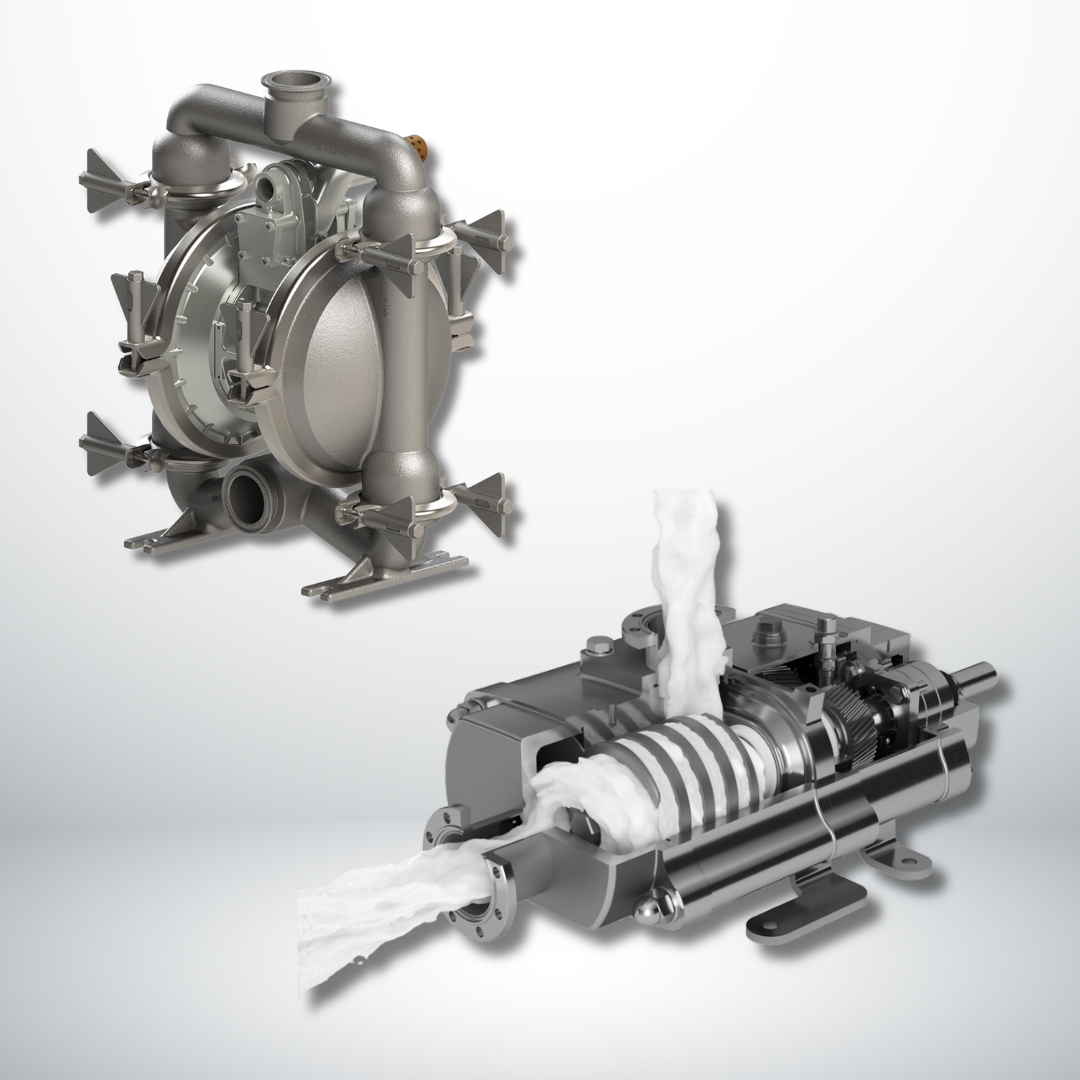
Rotary lobe pumps are among the most CIP-compatible designs available for food and beverage duties. Their relatively simple internal geometry, polished wetted surfaces, and front-loaded maintenance access make them well suited to in-place cleaning, and most hygienic lobe pump designs are engineered with CIP flow paths built in from the outset.
Peristaltic pumps take a different approach entirely. The process fluid only ever contacts the interior of the hose, so CIP of the fluid path is essentially a hose flush rather than a cleaning of multiple internal components. Progressive cavity pumps can also be designed for CIP compatibility, provided the rotor-stator interface, the part of the pump most prone to product accumulation, is addressed with CIP ports and smooth transition geometry.
The pumps that present the most CIP challenges are those designed for general industrial duties and retrofitted into food applications. Standard mechanical seals, rough internal castings, and complex wetted geometry make thorough in-place cleaning difficult, and in many cases impossible to validate with confidence.
The production and compliance consequences of a poor CIP specification
Cleaning validation requires demonstrable evidence that a CIP cycle consistently achieves the required level of cleanliness across every wetted surface. If that level of cleanliness is not easily validated, the risks and potential consequences compound from there.
A pump that retains product residue after a CIP cycle is a biofilm risk, and biofilm is persistent and difficult to eliminate once established. In a facility running multiple product types, a pump that adds extra time to every CIP cycle becomes a measurable constraint on throughput across every production run, not just an occasional inconvenience.
Food businesses are also required to demonstrate that their cleaning and sanitising practices are effective and properly documented, and a pump that's difficult to validate places an ongoing documentation burden on the quality team and creates a recurring point of vulnerability in the audit record.
Choose the right CIP system for you
CIP performance is a specification variable, not a given, and the decisions made when selecting a pump have direct consequences for how cleanable a production line is, how long cleaning takes, and how confidently a facility can demonstrate compliance with Australian food safety requirements.
If you're working through a food and beverage pump specification and want CIP performance built into the selection process from the start, Kelair's team is available to help.